Sunday, April 14, 2013

Value

Pablo Picasso. The Kitchen. Paris, November 1948
The Kitchen


Pablo Picasso
MoMA NY
November 1948
Oil on Canvas
69" x 8' 2 1/2"


          Pablo Picasso was a Spanish painter, printmaker, sculptor, ceramicist, and stage designer. He was born Pablo Ruiz y Picasso October 25, 1881 and died April 8, 1973. A precocious draftsman, Picasso was admitted to the advanced classes at the Royal Academy of Art in Barcelona at 15. After 1900 he spent much time in Paris, remaining there from 1904 to 1947, when he moved to the South of France. Picasso had many different styles in his works like his Blue Period, Rose Period, and Cubism.

         Picasso created this somber, existential work at the end of a series of large-scale monochromatic paintings all of which depict scenes of violent turmoil. The works restricted, mute abstraction may be a response to Europe's then recent atrocities, (Picasso had just returned from his first visit to the Nazi Concentration Camp in Auschwitz, Poland), as well as the loss of a great friend, his good friend poet Guillaume Apollinaire, who had passed away thirty years before. Picasso wanted to strengthen the emotional impact of things like war through his works. I believe he has done this using value. He used black, gray, and white to show that emotion. I feel that the agony is shown through the dark tones.


http://www.moma.org/collection/object.php?object_id=79668
 

Tuesday, April 2, 2013

Proportion/Scale

                                                   Big Yellow Rabbit


The Big Yellow Rabbit
Artist Florentijn Hofman
Örebro, Sweden
Concrete, metal, wood and takspån (sweedish pine shingles used for roofing)
13 x 16 x 16 meters
 
 
         Florentjin Hofman is a Dutch artist. Born  April 16, 1977 in Delfzijl, Netherlands. He received his Masters in Art in Berlin, Germany in 2001. Hofman likes to create larger than life sculpture of everyday things from giant bunnys, pigs, slugs, dead flys, rubber ducks, and colorful paper boats to painting entire buildings one solid color so people will start looking again at what was and is there. Since 2000, his installations have appeared all over the world. 
         Hofman: 'My sculptures cause an uproar, astonishment and put a smile on your face. They give people a break from their daily routines. Passers-by stop in front of them, get off their bicycle and enter into conversation with other spectators. People are making contact with each other again. That is the effect of my sculptures in the public domain.'
          The Big Yellow Rabbit was a temporary 13 meter high sculpture. Hofman, and his design firm, are best known for their larger than life sculptures and clever statues. In this photograph, Hofman and his team created an enormous yellow bunny in the middle of the town square in Sweden. The bunny provides a new focal point to the public space, which once was the Statue of Engelbrekt (standing behind the rabbit). The sculpture provides a new experience to people who regularly use this space for shopping, restaurants, and church. Florentijn Hofman encouraged Orebro visitors to examine the space both with the bunny, and then again after its removal. The 43 foot high rabbit is hand constructed with Florentijn Hofman’s team and 20 volunteers. The sculpture is made on site, of all local materials, wood, some metal, wood shingles, and paint. Each wood shingle was screwed on, one by one! It’s only when you are up close that you can understand the detail and precision that went into its making. The work was seen seen during the summer of 2011 during the OpenArt biennale.
 
        I love these larger than life constructions because they take you back to your childhood. The exaggerated scale of  his works are seen all over the world. He has a giant rubber duck that swims the world from New Zealand to Japan. A giant, fat monkey that lies stretched out in a park in Brazil, and countless others that greatly impact all who see it. An encounter with one of his extraordinary pieces invites you to stand still for a moment and look; to really look.   


Saturday, March 9, 2013

Line + Movement

An Apparatus for Digesting Thoughts- 1997
Steve Aubrey
Lenticular Stereogram
16 X 16 inches 
 
     Steve Aubrey is a professional computer artist in San Jose, California. He creates unique abstract images in stereoscopic 3D. His works are laminated with a special lens that allows the viewer to see his pieces in 3D. This process is called Lenticular. The most unique aspect of Aubrey’s art work is the experience they provide for those who see it. When you walk up to an Aubrey work, the image you see is determined by the angle at which you are viewing the picture. When you walk back and forth in front of the picture, the image changes. Not only does the shape change, but, in most cases the color does as well. Steve Aubrey's works have been seen at MooBoo gallery in Oakland, CA.

       I love this piece because it creates such an eye popping effect. The lines and shading being used have a sense of thick and thin that help create movement through the piece. His inclination toward the creation of this piece seems to mimic the golgi apparatus inside of a cell. Because of this, it is an interesting fact to know that Steve Aubrey's career began with photography of Anatomy for Stanford University.  


Monday, February 18, 2013

Shape


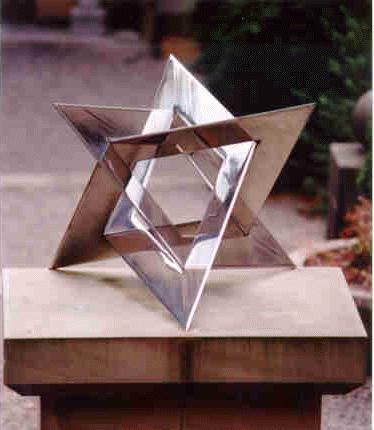
GENESIS- 1995
John Robinson
Polished Stainless Steel
3 feet X 3 feet
University of Wales, Bangor


    John Robbinson, (1935-2007), was a British sculptor. In the late 1960's he began sculpting with modeling clay where he sculpted friends and children. In 1983 he opened the Freeland Gallery where he collaberated with another artist to create a "Symbolic Structures and Tapestries" exhibit. In the 1970's, he began his Universe Series of Symbolic Sculpture of which is made up of more than 100 pieces.e early 1970s Robinson be
   
     In this piece, titled Genesis, it is being described by Robinson as "The never ending renewal of life", in that each rhombus is giving birth to a rhombus, as IT is being born itself.
(The rhombus is thought to be the Celtic symbol for fertility.) The planes of Genesis cross at right angles and mimics the Borromean Ring principle in appearence. I like how the simple rectangular shape used, as well as the high polished metal, conveys how life can be continually renewed.


http://www.popmath.org.uk/sculpture/pages/2genesis.html


Thursday, February 7, 2013

line

Click here to go to 'Vincent's Chair with His Pipe' page.
Vincent's Chair with His Pipe,  Arles:December 1888
Oil on canvas  
93.0 X 73.5 cm
London National Gallery


        Vincent Willem Van Gogh (1853-1890), was a Dutch Post-Impressionist artist. He began drawing as a child, but, did not start painting until his twenties's. In his early adult years he worked with art dealers. For a while, he considered the life of a pastor. He became a missionary in Belgium, sketching people in his spare time. In 1885, while living in Belgium, he decided to start painting. Even though his begining works were dull in color, once he moved to France, in 1886, his works brightened up with bold colors. During his lifetime, he created more than 2100 pieces including oil on canvas, watercolors, sketches, and prints. Throughout his life, Van Gogh struggled with bouts of depression and was hospitalized for mental illness. On July 29,1890, Van Gogh died from an infection steming from a gunshot wound he had received two days prior. Some say it was self inflicted, even though the gun was never found.
   
        I like how Van Gogh uses line to define shape, like at the base of the wall and on the chair. The blue outline on the chair ties it into the the color on the wall. His use of vertical and horizontal lines on the floor tiles gives the piece definition and harmony.  He also uses line to create texture on the chair and the onion box. I chose this piece because of the simplicity of it. It almost has this "loner" effect. (Even though I know it has a companion piece painted by Gauguin). I have a sketch of this, that a student drew for me, on a small piece of scratch paper. Not only is it one of my favorites but, it was one one of Van Gogh's as well.  


http://www.vggallery.com/painting/p_0498_0499.htm